
Your business rules.Working across your systems.
Your systems perform the functions. ROS makes them work together as your business requires.
ROS runs the complete process: applying your rules, coordinating system actions, retaining each request's progress, and checking the required result. ViaROS implements the logic, connections, and additional functions that make it possible.
Because ROS executes that company-specific process, the rules directing the work stay connected to the history of what happened. Your team and chosen AI can examine what should happen, what actually happened, and where delivery can improve.
Keep that operating foundation as you improve delivery, launch new services, and change technology.
0000+
Processes deployed in ROS
Since 2017
Executing company specific processes
Hundreds
Processes running at individual clients
00 million
Errors resolved automatically at one client in one month
Your business logic in action.The context behind your results.
How ROS puts your systems to work
Build your customer promise into the complete process.
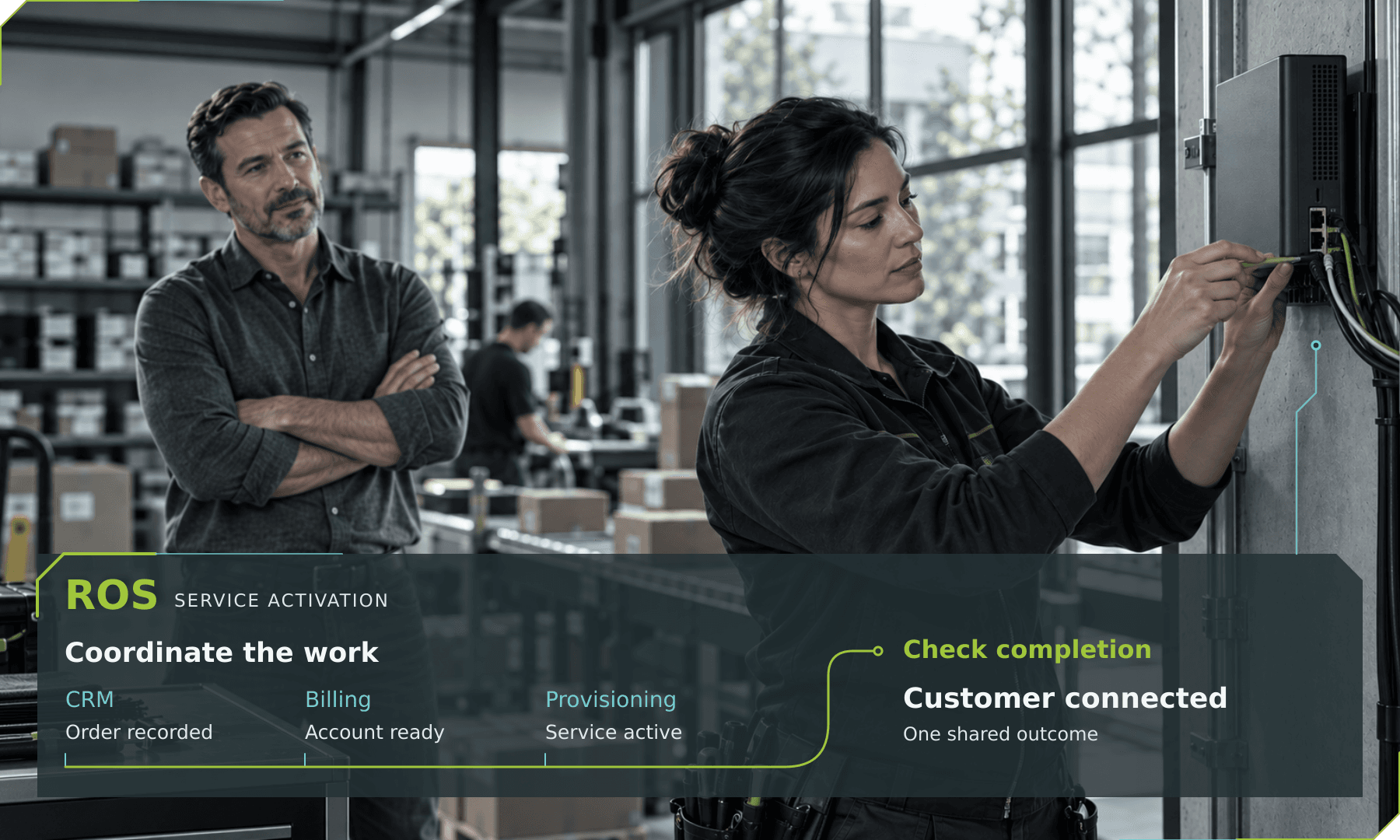
Suppose a new customer orders your service. Your requirement is simple: start charging only after the service is confirmed active.
ViaROS implements the complete activation process in ROS. Your business logic determines the decisions. Integrations connect the systems. Orchestration coordinates their work around the result your business needs.
What the process needs
- Business logic: your rules and decisions.
- Integrations: connections to your systems.
- Orchestration: coordination of the work.
- Completion: confirmation of the result.
What ROS does in this example
- Allows charging to begin only after service activation is confirmed.
- Exchanges information and requests actions from CRM, billing, and provisioning.
- Coordinates setup and activation, waits for confirmation, then requests charging. If activation is delayed, charging waits.
- Checks the required service and billing confirmations before recording the activation as complete.
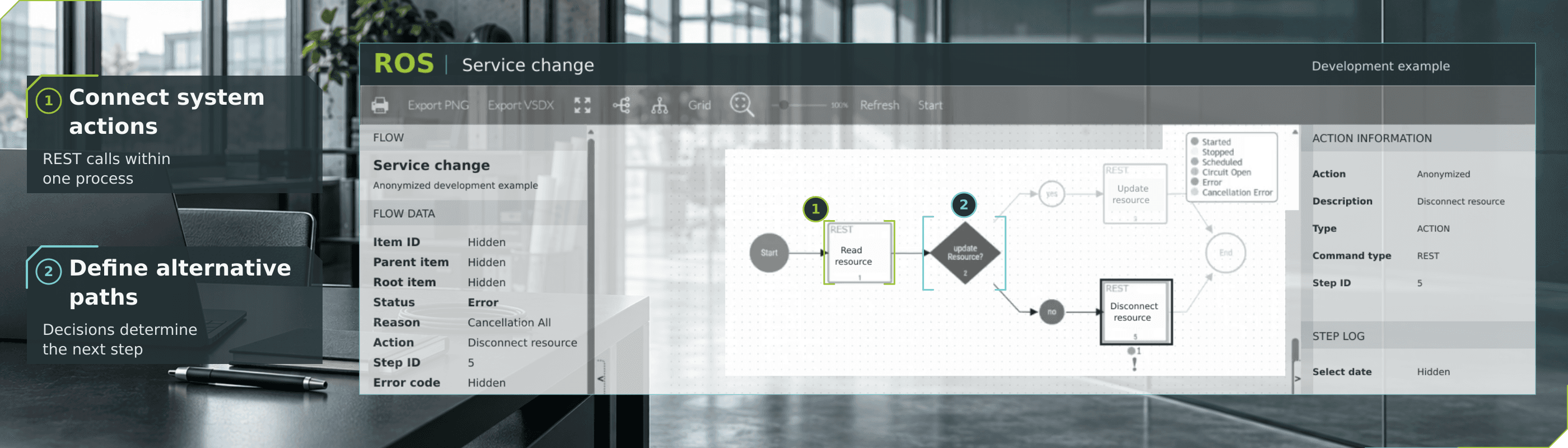
The same process can follow different paths for different products or customer conditions. A reusable flow can perform part of the work, such as an account check, within the larger activation process.
Where your existing systems cannot perform a required function, ViaROS develops what the agreed process needs.
Your requirement becomes behavior carried out for each customer. The complete process connects the promise, the systems, and the result.
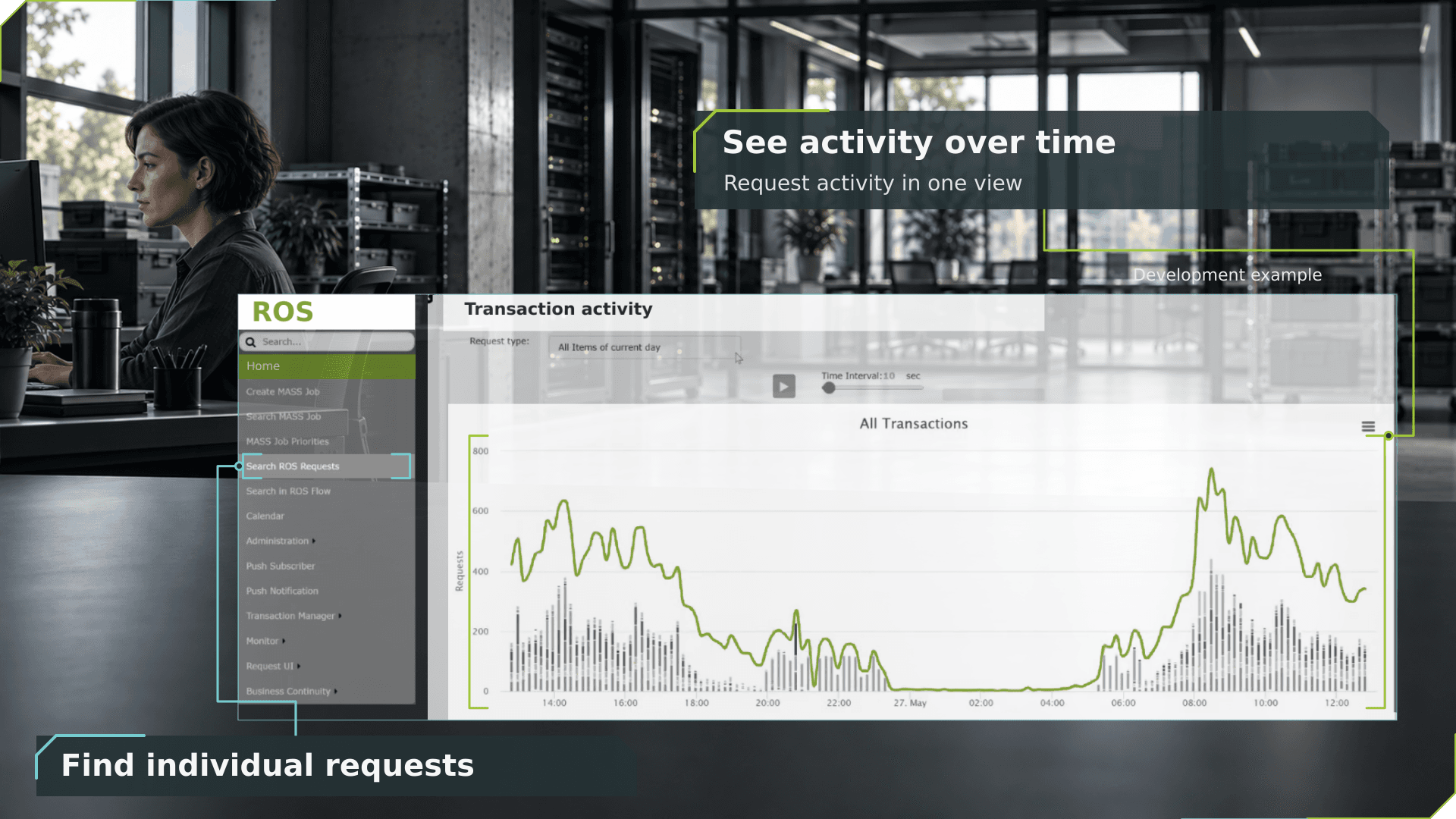
Follow every request. Know what happened.
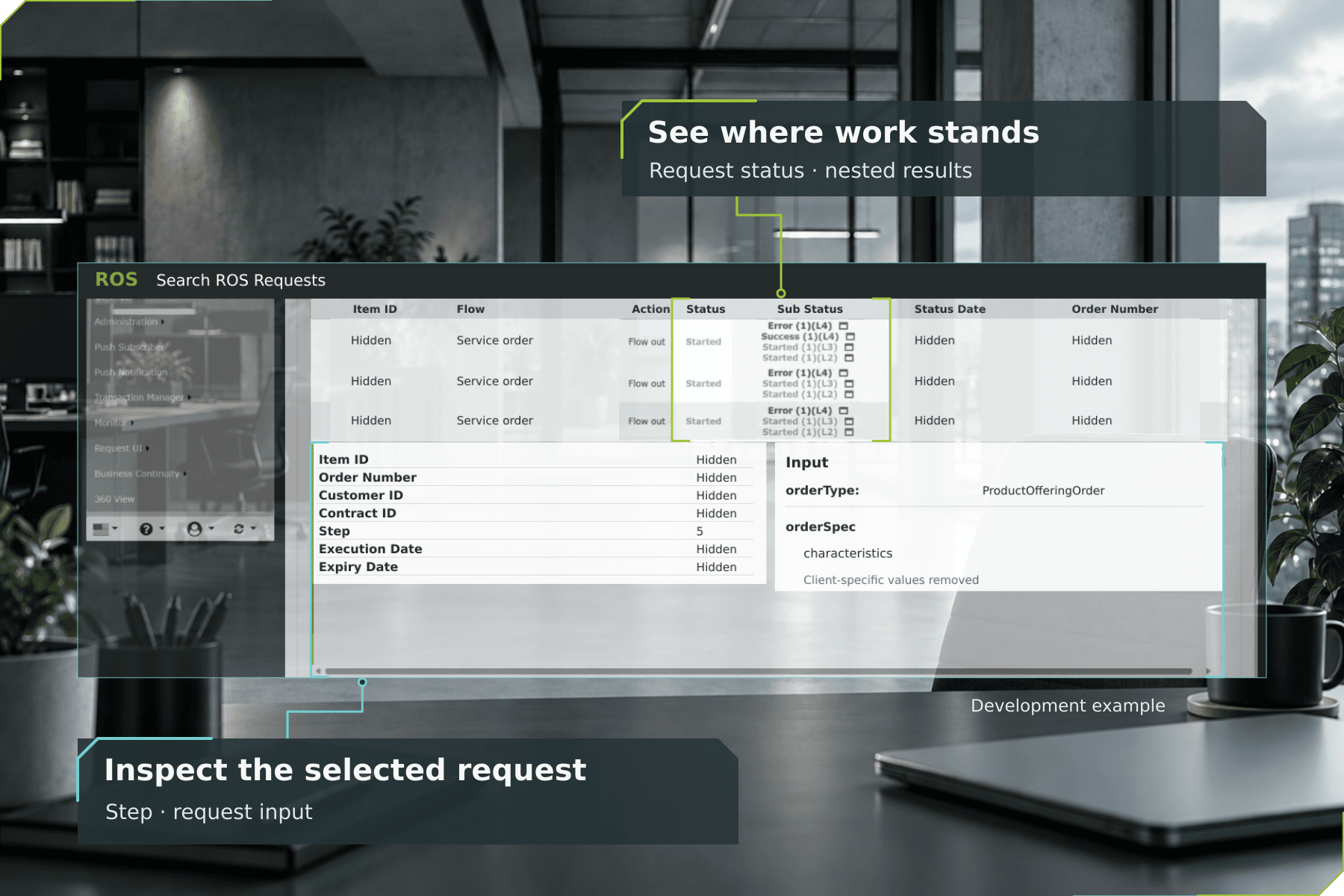
Each order, payment, or service request has its own execution in ROS. Its decisions, system interactions, waits, and attempts remain connected under one identity, with its progress retained. Work can run in sequence, in parallel, or wait for a later response.
Your team can inspect where the request stands, what the systems returned, and which requirement remains outstanding.
Follow progress across the participating systems, including work still waiting.
Locate the affected request and examine its steps, information, and recorded responses.
Record success when the configured completion requirements have been met.
Work can run in sequence, in parallel, or wait for a later response while remaining part of the same execution.
The execution history stays connected to the process that directed it. That gives people and connected AI a way to examine a result in its business context.
Recover today’s transaction. Improve tomorrow’s execution.
When work stops, ROS identifies the affected execution, the failed step, and the reported response. Your team can examine recurring conditions and retained attempts across requests to understand what needs attention.
Known conditions use the approved handling built into the process. For new conditions, ViaROS works with the relevant system owners to investigate and resolve the issue, then develop a response for future matching conditions.
After approximately six weeks in production, recurring errors are reduced to near zero.
Recognize
Match the reported condition to an approved response.
Respond
Apply the retry, correction, or other handling defined for that condition.
Verify
Check the resulting state against the process requirements.
Investigate
Inspect the failed step, recorded response, retained progress, and earlier attempts.
Resolve
Correct the affected work with the relevant system owners.
Harden
Implement, test, and approve handling for future matching conditions.
The tested solution stays in the process. Your business keeps the handling it has developed, reducing repeated investigation and manual recovery while improving delivery.
Give AI the rules behind the work. And the history to understand it.
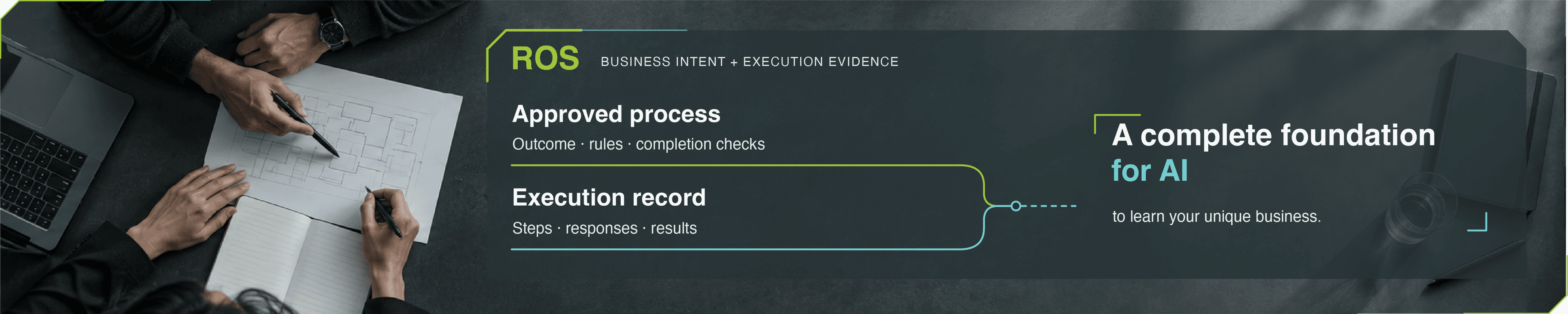
Because ROS runs the process, your chosen AI can examine the rules directing the work and the evidence of how it actually ran. Results can be understood alongside the decisions, dependencies, and responses behind them.
Shared customer IDs connect activation, payments, upgrades, and recovery across processes running in ROS
The process ROS executes
Your rules, system roles, dependencies, recovery responses, and completion requirements.
The history ROS records
Each request’s path, information, system responses, failures, recovery, and result.
Company-specific context for your chosen AI. What should happen. What happened. How the two relate.
Understand the customer experience
Examine a customer's activation, payments, upgrades, and recovery together to understand what happened and how your operation contributed.
Find where delivery can improve
Investigate recurring delays and dependencies. For example: Where did delayed activations wait, and did charging stay on hold until service was confirmed active?
Evaluate what comes next
Explore which processes and system dependencies a proposed change could affect, then compare recorded results after implementation.
ROS connects the rules it executes with the history it records, giving your chosen AI the context to help explain results, improve delivery, and evaluate your next move.
Let systems change. Keep the operation you designed.
The business rules, system coordination, and tested handling established in ROS become an operating foundation your business can retain and adapt. ROS holds the cross-system logic separately from individual application interfaces.
Connect the environment you have.
Legacy applications, modern platforms, and microservices can participate in the same process.
ROS uses their capabilities under your business rules, with the connections and response handling that process requires.
Update what changes. Test the complete process.
When a billing platform changes, ViaROS reviews its connections, information, and effects on dependent steps.
In our activation example, service confirmation before charging can remain the requirement while the implementation is adapted and tested.
Your next technology investment builds on the operation your business has already established.
Turn working processes into more business possibilities.
A flow in ROS can run within a larger flow, and an established process can serve more than one channel. ViaROS combines the capabilities that fit and adds the rules and functions your next requirement needs.
Each new initiative builds on useful operating logic, tested handling, and execution history.
Reuse a working function
An account-checking or notification flow can serve several processes, with the settings each one requires.
Open another channel
A website or partner channel can invoke an established activation process through its agreed inputs.
Deliver a complete journey
Activation can become part of onboarding, coordinated with equipment delivery and customer communications.
Introduce a new offering
Combine established activation, payment, and notification flows with the additional rules a new service requires.
More connected processes expand what your business can deliver and what your chosen AI can examine.
Your first process, delivered in weeks.
Bring the business goal and the systems you have. ViaROS works with your business and technical teams to define, implement, and test the complete process in ROS.
We reuse your existing capabilities and ROS components, focusing development on the connections, controls, and functions the process needs. Scope, system access, readiness, and timing are agreed before implementation.
Define the complete process
01Agree the outcome, decisions, system roles, dependencies, and completion requirements.
Connect existing capabilities
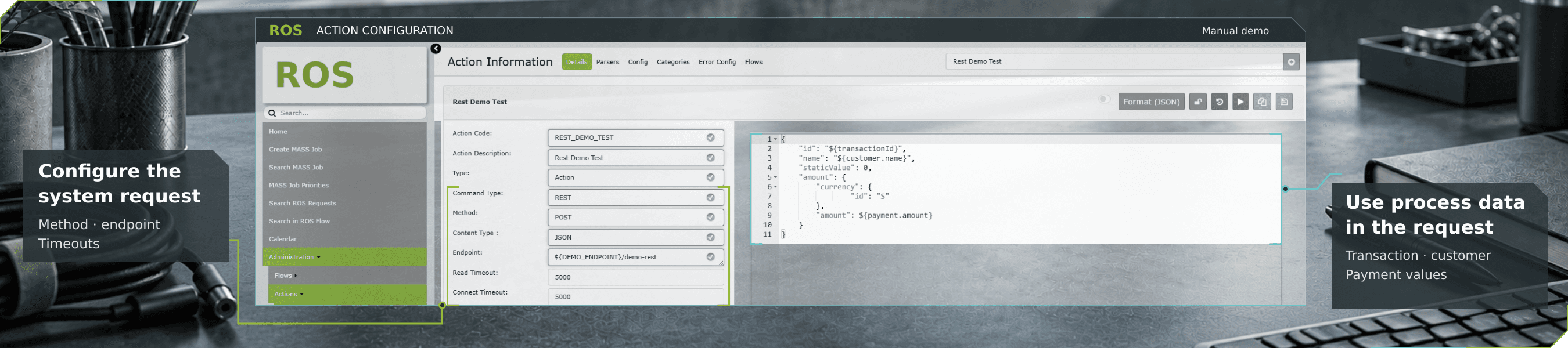
02Use reusable actions to call your systems, transform information, and pass results between steps.
Build what is missing
03Develop the agreed connections, controls, custom actions, or microservices needed for the process.
Test and run
04Test the complete execution, obtain your approval, and prepare it for production and ongoing improvement.
Start with a meaningful result and a foundation your business can build on.
Inside ROS
Your process becomes executable software through these reusable components:
Execution and connections
ROS supports synchronous calls, asynchronous responses, parallel work, and long-running dependencies while retaining each execution's state. REST and SOAP services, databases, files/SFTP, Kafka, and JMS connect the systems involved, with data transformations and response checks configured for the process.
Telecom uses include:
Customer Order Management (COM), Service Order Management (SOM), and orchestration across Business Support Systems (BSS) and Operations Support Systems (OSS).
Configured recovery
The process specifies when to use targeted retries, corrective actions, compensation, or controlled cancellation. Compensation uses defined actions to address the effects of earlier work; its scope depends on what the participating systems support.
What could your business achieve with one complete process working on your terms?
Bring a customer promise, a stalled initiative, or a recurring operational problem, along with the systems involved. We’ll explore the result you need, how ROS could execute the complete process, and what that would make possible for your business and AI.
In a ROS demo, follow a request through its rules, system actions, recorded responses, and handling when a step fails. See the foundation your business could strengthen and build on.
Support